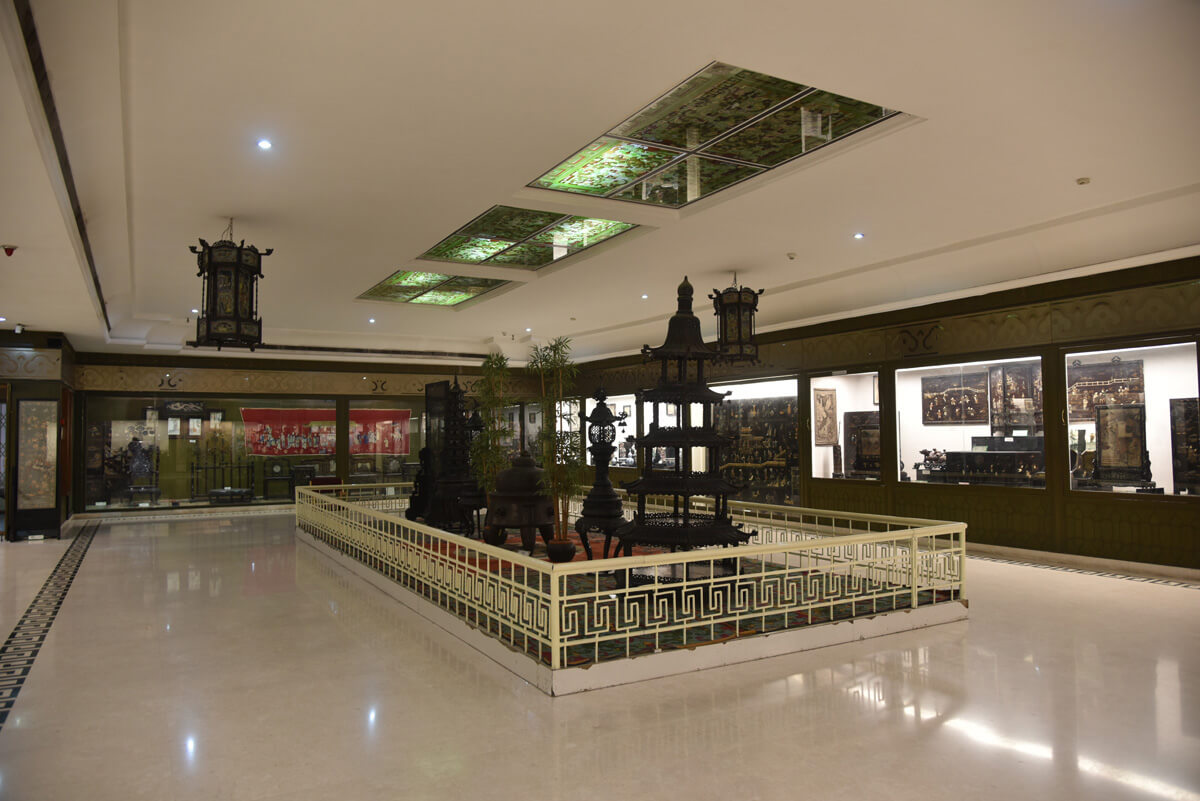
The Far Eastern art collection at the Salar Jung Museum is extensive and diverse, and ranks among the finest of its kind in South Asia, South-East Asia, and Australasia. (Avoid the subjective phrase “could easily rank”.) The Chinese and Japanese collections together comprise approximately 5,000 objects. (Corrected “compromising” to “comprising”.) Approximately 40 per cent of the collection was acquired by Salar Jung III, while the remaining 60 per cent was inherited as part of the Salar Jung family collection.
Approximately 960 Chinese and Japanese objects are displayed across four galleries on the museum’s first floor. The Chinese collection is distinguished by its remarkable assemblage of porcelain dating from the twelfth to the nineteenth centuries. It compares favourably with renowned Chinese porcelain collections held outside China. The museum houses nearly 300 pieces of celadon ware representing the Song (AD 960–1279), Yuan (AD 1271–1368), Ming (AD 1368–1644), and Qing (AD 1644–1912) dynasties. (Updated to the modern and historically accepted romanisation and dates.)
Among the earliest examples in the collection are two celadon plates: one decorated with a raised dragon and fish motif, and the other featuring a dragon in relief at the centre. Both are dated to the twelfth and thirteenth centuries, during the Song dynasty. Among the Ming celadons is a large group of fifteenth-century plates decorated with a diaper pattern at the centre and incised peony motifs around the border. The museum also possesses two finely decorated jars featuring bands of floral motifs from the Zhengde period (AD 1506–1521). (Corrected “Chengate” to “Zhengde”.)
The Chinese Gallery also displays large silk embroideries from the late Ming dynasty (seventeenth century). One depicts the Taoist God of Longevity, while the other portrays a messenger announcing the results of the imperial civil service examinations. (Historically more accurate than “university”.) The museum also houses fine examples of eighteenth-century Chinese jade carving, demonstrating the exceptional craftsmanship and technical mastery of Chinese artisans. Highlights include elaborately carved jade boxes bearing Qianlong reign marks and a sculptural stand in the form of three intertwined dragon lizards from the Qianlong period (1735–1796). (Updated “Chin Lung” to the accepted romanisation “Qianlong”.)