One of the most significant influences of Persian art to India’s cultural heritage is the application of exquisite decorative techniques to articles of everyday use. One of the finest examples of this tradition is Bidriware, which originated in the city of Bidar, approximately 145 km from Hyderabad, in present-day Karnataka.
Bidriware dates back nearly four hundred years to the Bahmani and Barid Shahi dynasties, under whose patronage the craft flourished and attained its highest level of refinement and artistic excellence.
The basic material used is an alloy of zinc, copper, and lead, unlike the iron and copper traditionally employed by Persian craftsmen for inlay work. This alloy is highly resistant to corrosion, although it is comparatively brittle.
By the close of the eighteenth century, traditional Indian crafts had begun to decline as they gradually lost the patronage of the nobility, who had supported the arts for centuries. The markets of Hyderabad became filled with priceless examples of earlier Bidri ware that had been discarded from aristocratic households. These objects, however, attracted the attention of British officers serving under the Nizam. Just as E. B. Havell worked towards the revival of traditional Indian painting, Prof. E. E. Speight of Osmania University, Hyderabad, made significant efforts to revive the craft of Bidriware. With changing times and evolving social needs, Bidri objects gradually adopted new forms and decorative motifs.
Among the finest surviving collections of early Bidriware are those in the Salar Jung Museum, the National Museum, New Delhi, the Hyderabad Museum, and the Ratan Tata Collection at the Chhatrapati Shivaji Maharaj Vastu Sangrahalaya (formerly the Prince of Wales Museum), Mumbai. Significant collections of Bidriware are also preserved by several prominent families in Hyderabad.
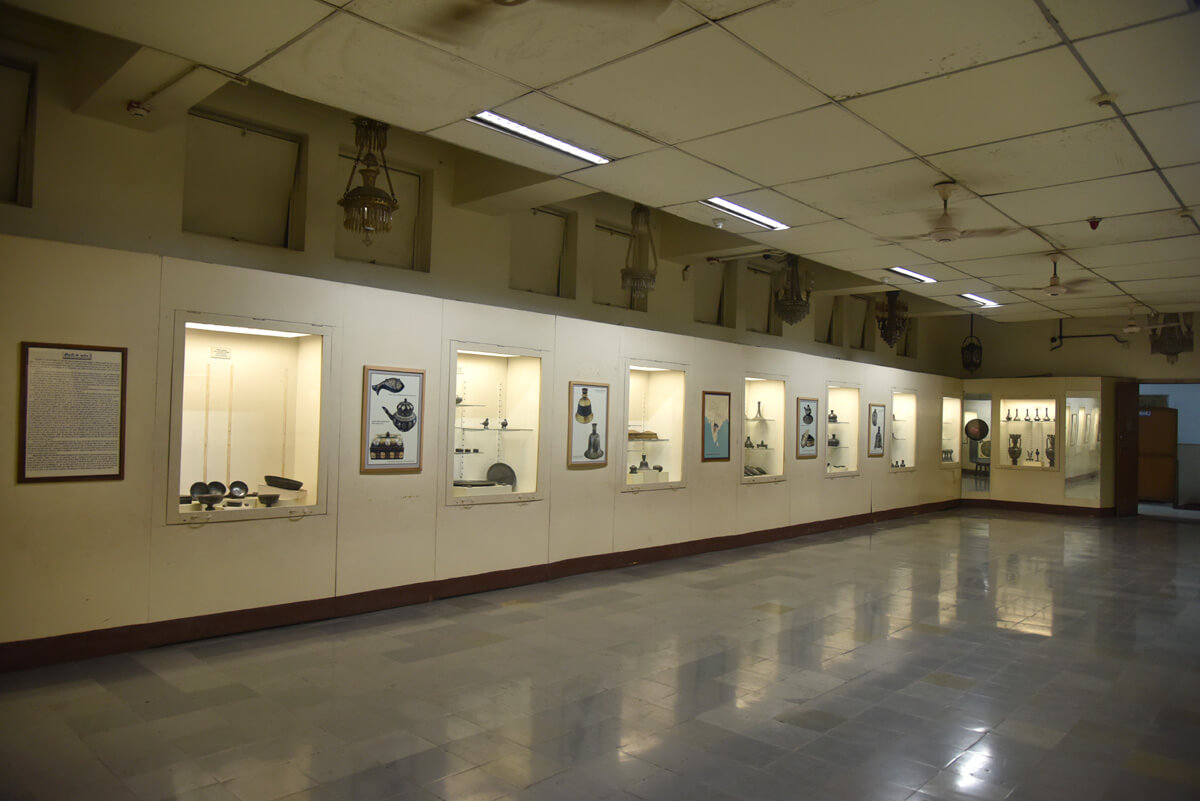
The Bidriware in the Salar Jung Museum represents a wide variety of forms, designs, and craftsmanship. The Museum houses nearly 200 pieces of Bidriware in a variety of shapes and sizes.
Distinguished by their varied forms and designs, huqqahs constitute an important part of the museum’s Bidri ware collection. They represent excellent examples of the principal decorative techniques employed in Bidriware, including Tarkashi, Tahnishan, Zarnishan, Zarbuland, and Aftabi. The collection also includes a few fine examples featuring gold inlay.
The collection also includes chilams (fire cups) and mundals (mouthpieces). (Term should be verified against collection records.) A large chilam, decorated with flat silver strips using the Tahnishan technique, is a particularly striking example. Other important Bidri objects include the Sailabchi (wash basin) and the Aftaba (ewer). These vessels were commonly used in both the zenana and the gentlemen’s reception rooms. The collection includes a pair of large, circular Sailabchi basins with perforated central covers, together with an Aftaba fashioned after the Persian wine flagon.
The widespread use of Bidri ware in household objects is demonstrated by Mir Farsh weights, which were used to keep chandnis (white floor coverings) and other cloth spreads smooth and in place. The museum possesses several such beautifully decorated examples.