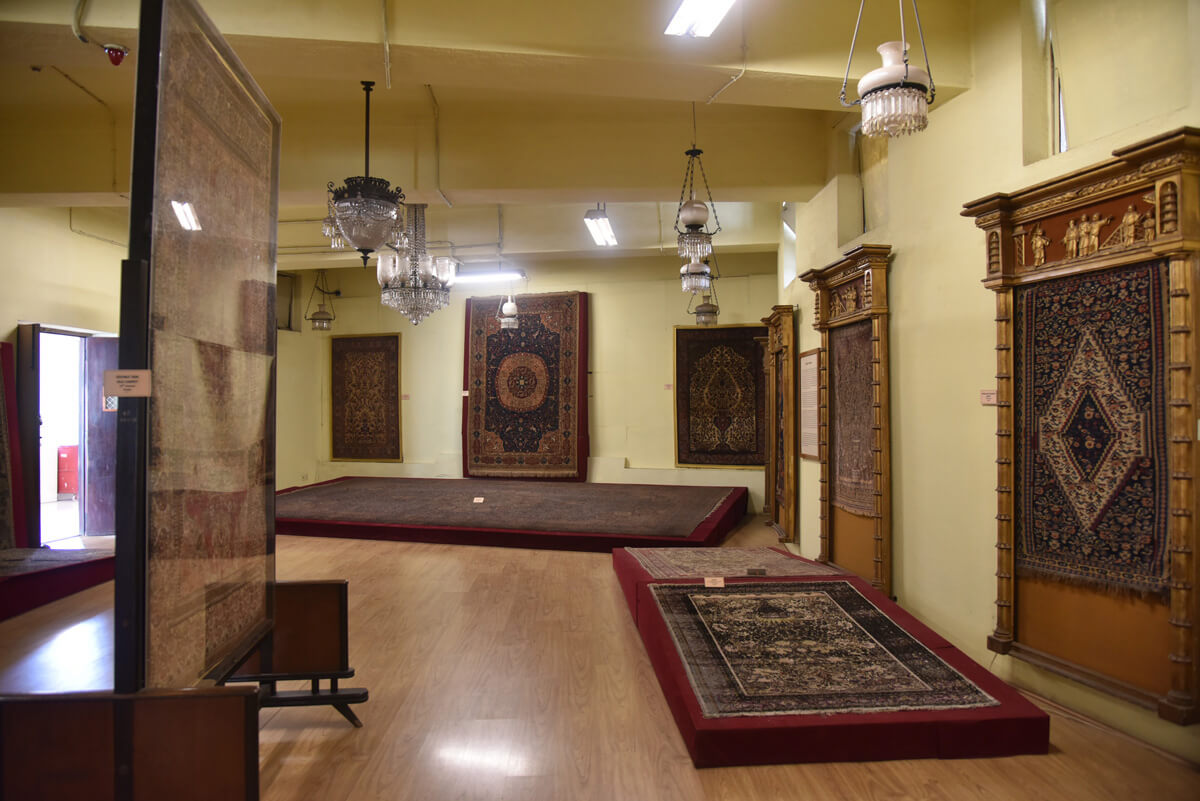
Persia has long been renowned as one of the world’s greatest centres of carpet weaving. The sixteenth century marked the zenith of the Persian carpet industry under the Safavid dynasty, particularly during the patronage of Shah Abbas I (r. 1588–1629). Following the death of Shah Abbas, the art of carpet weaving gradually declined by the early 18th century. The Persian carpet industry experienced a revival only during the 19th century.
Persian carpets occupy a distinguished place within the Museum’s West Asian and North African collection. Although carpets served practical purposes as floor coverings, door or wall hangings, and decorative furnishings, they are equally admired for their artistic excellence and craftsmanship. The gallery displays exquisite examples featuring intricate weaving and a variety of ornamental designs from some of Persia’s most celebrated weaving centres, including Kashan, Bokhara, Tabriz, Kirman, and Shiraz.
The museum houses several Bokhara carpets woven by Turkoman tribes. These carpets feature elongated octagonal motifs arranged in rows of diamond-shaped patterns, with straight lines connecting the centres of the octagons. At the centre of each octagon is a woven eight-pointed star. These carpets date to the eighteenth century.
The gallery also contains carpets with woven figurative scenes. One such carpet depicts Khusrau on horseback and Shirin seated on a terrace. Swimming ducks and fish appear in the foreground, while the surrounding borders are decorated with Shikargarh (hunting) scenes.
It was during the sixteenth century that high-quality prayer rugs were first designed and woven in Iran. The museum houses an impressive collection of prayer carpets. Persian weavers also incorporated metal threads into the production of carpets. One such carpet woven with metal threads in the Museum’s collection was produced in Kashan. The foundation of this carpet incorporates gold thread, consisting of extremely fine flat metal strips brocaded into the warp and weft.